
We help teams build better AI products and become better at building with AI.
We identify where AI can create real value, rapidly prototype the experience, and define the system required to scale it.
We turn existing product knowledge into better context, faster prototypes, and more effective AI-assisted delivery.
"We shipped AI features. Adoption is flat."
Nothing changed in the workflows around the AI. Intelligence added to the surface of an unprepared product doesn't stick.
"Our team is split on AI strategy."
Some want an AI-first rebuild. Others think targeted accelerators are enough. What's missing is a workflow-by-workflow read on what's actually ready.
"Leadership wants AI on the roadmap. Engineering wants direction."
Without a defensible diagnosis, every AI initiative is a bet rather than a decision.
"Our team has the tools. The output isn't good enough."
Access to AI tooling is table stakes now. The quality gap comes from context, standards, and judgment.
Where should AI change the product?
We find the workflows where intelligence earns its place, and the ones where it doesn't. You get a prioritized view of what to build now, what needs fixing first, and what shouldn't be funded yet.
Ship it
We design and build the AI experience as working software. Chat, inline guidance, a copilot, an adaptive surface — we choose what fits the task, then build it so your team can put it in front of real people before committing to production.
What has to exist behind it?
We define the system the experience depends on: what it knows, what it can do, what it can't, where a human stays in control, and how you'll know it's working. Your engineering team gets a clear product-level model to build against.
AI tools can generate an interface in minutes. Whether that interface is worth shipping depends on what the tool was told — your customers, your business rules, your workflows, your design system, your constraints. Most teams feed their tools almost none of it.
Not a course on prompting, but a working method for turning knowledge your team already holds into AI-assisted output you'd put in a release.
We start with the work your users are trying to finish, not with what a model can produce. Where effort, ambiguity, and interpretation pile up is usually where intelligence pays off. Where the workflow is unclear or the data is trapped in someone's inbox, AI makes things worse — and we'll tell you that before you spend on it.
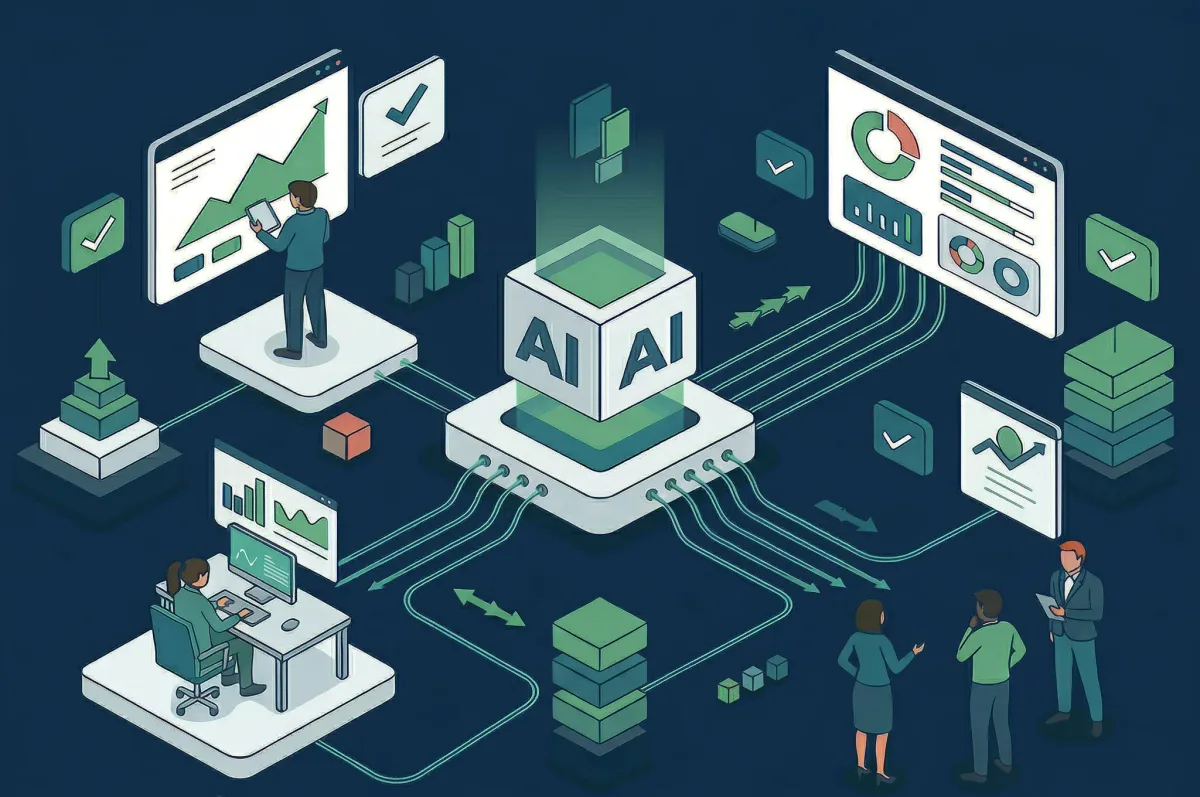
We designed an AI troubleshooting panel into the job detail view operators already trusted — it recommends, it never acts.
Learn moreUsers describe what they want to automate in plain language; the system fills structured fields, each requiring confirmation.
Learn moreWe rebuilt a 12-screen process into one canonical workflow, then added a voice-capture path on top of it.
Learn moreAI-first opportunities usually mean rethinking the product model, not adding a feature.
Connected AI depends on understanding how users, operations, data, and services actually fit together.
AI experiences need reusable patterns, structured output components, and stronger design-to-development workflows.
Priorities, tools, and policies keep moving. Some teams want a partner who stays.
Begin with a Workflow Intelligence Assessment and get a clear read on where AI belongs.
Start with an assessmentBegin with a conversation about how your product and design teams work with AI today.
Explore team enablement

