How do you enhance a system people depend on without breaking what already works?
AI does not need to replace established workflows to create value. This project demonstrates how embedded intelligence, paired with disciplined information architecture, can enhance a mission-critical enterprise platform — increasing clarity, speed, and trust while preserving operator control and system integrity.
JAMS is a mature enterprise automation platform trusted to orchestrate complex, mission-critical workflows across technical teams. The system manages high volumes of jobs, dependencies, logs, and configurations — forming the operational backbone for organizations that rely on precision and uptime.
Over time, the platform’s flexibility and configurability had created a dense interface environment. Experienced users valued the control, but the cognitive load required to interpret logs, trace dependencies, and diagnose failures introduced friction — particularly under time pressure.
Any introduction of intelligence into this environment required more than feature enhancement. It required architectural sensitivity: preserving system integrity, respecting operator workflows, and embedding assistance without disrupting established patterns of control.
This was not a greenfield AI opportunity. It was a challenge of integrating intelligence into a system people already depended on.
We partnered with product and engineering leadership to embed intelligence within existing workflows without destabilizing system integrity. We led opportunity modeling and AI-assisted experience design, establishing patterns to support future intelligence expansion across the platform.
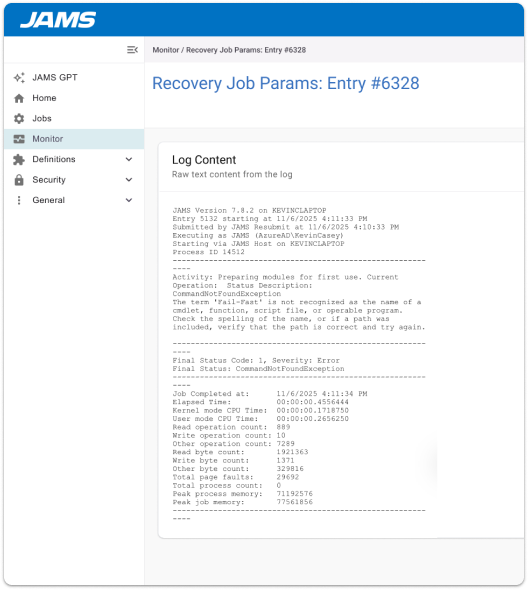
When jobs failed, users were presented with detailed logs, system metadata, and configuration outputs. The information was technically available — but interpretation required deep system familiarity and accumulated institutional knowledge.
Resolution often depended on experience, not clarity.
Users needed to quickly answer critical operational questions:
Support teams were frequently involved. Resolution time varied. New users faced steep cognitive barriers.
This was not a simple usability gap.
It was a structural challenge: How do you introduce intelligence into a mission-critical system without undermining reliability, eroding trust, or displacing operator control?
Replacing the interface with an automated decision-maker was not an option.
The challenge was to embed intelligence within existing workflows, enhancing interpretation and guidance while preserving system integrity and human authority.
Rather than introducing AI as a new interface or standalone assistant, intelligence was embedded directly within the existing job troubleshooting experience as a contextual interpretation layer.
AI was treated as structured reasoning support, not an automated decision-maker.
The strategy was guided by three core principles:
Intelligence analyzed execution context, error patterns, and historical job data within the job detail view where troubleshooting already occurs. Assistance was layered into the existing surface, preserving operator authority and system integrity.
Contextual, not global
Intelligence appears only where failures occur. It does not reframe the entire system.
Interpretation, not automation
AI translates logs and metadata into structured explanations but does not execute corrective actions.
Transparent outputs
Explanations reference familiar system concepts and configuration elements. Users can trace suggestions back to source data.
Explicit human control
No actions are taken automatically. Operators review and decide.
Foundation for expansion
Interaction patterns and integration boundaries were defined to support future intelligence capabilities without redesigning core workflows.

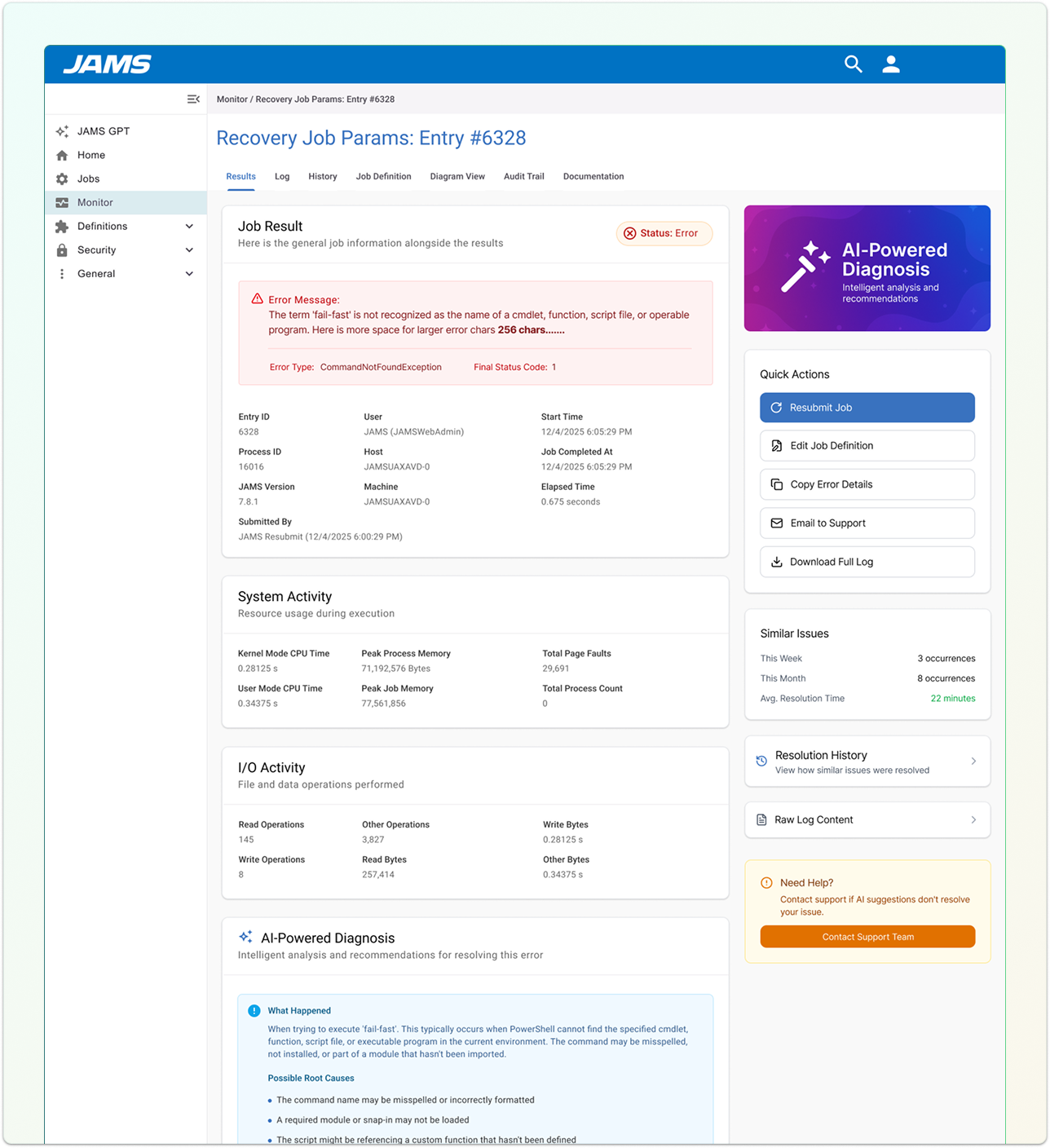
An AI-powered troubleshooting panel was introduced within the existing job detail view.
When a job failed, users could immediately access:
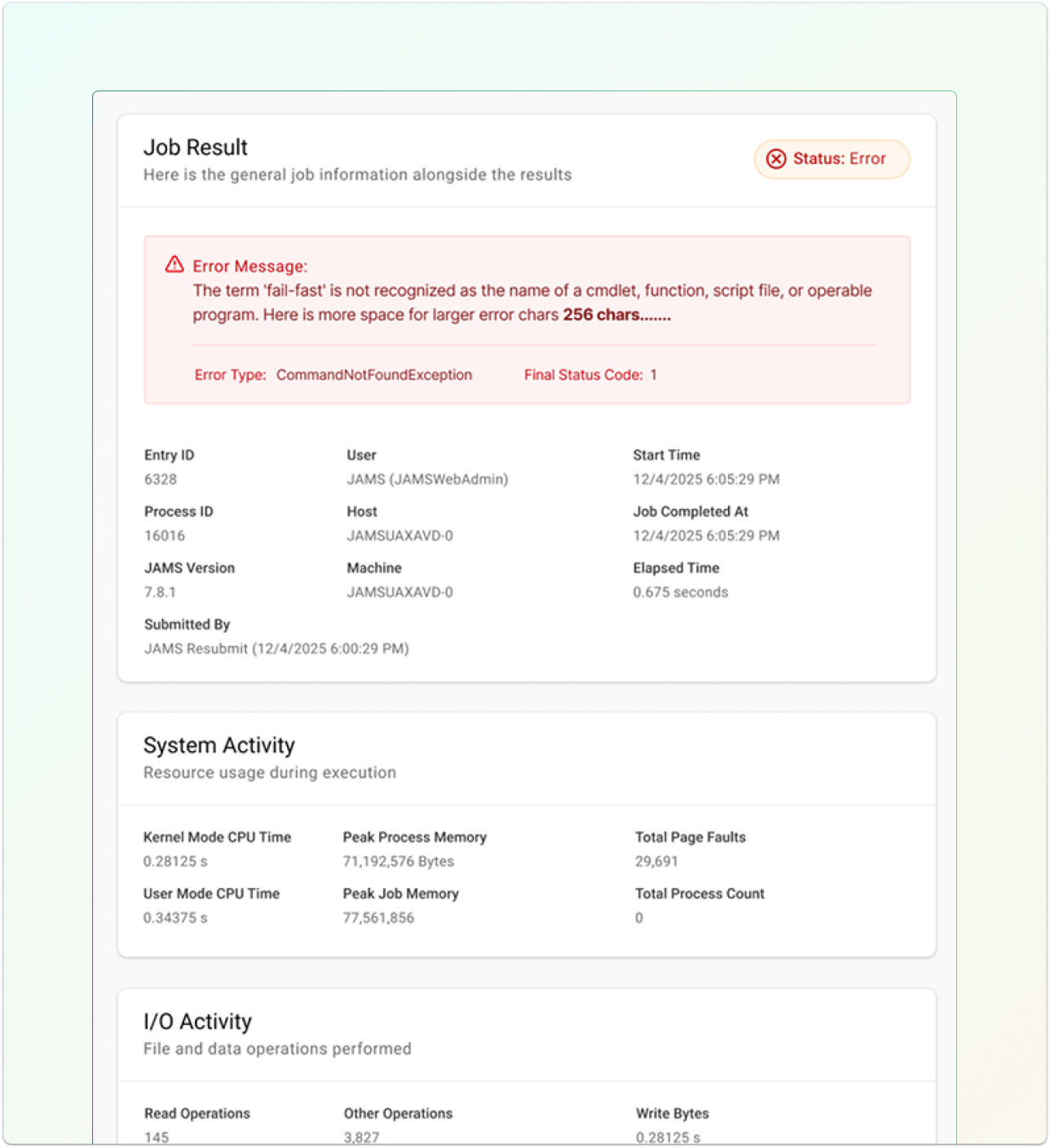
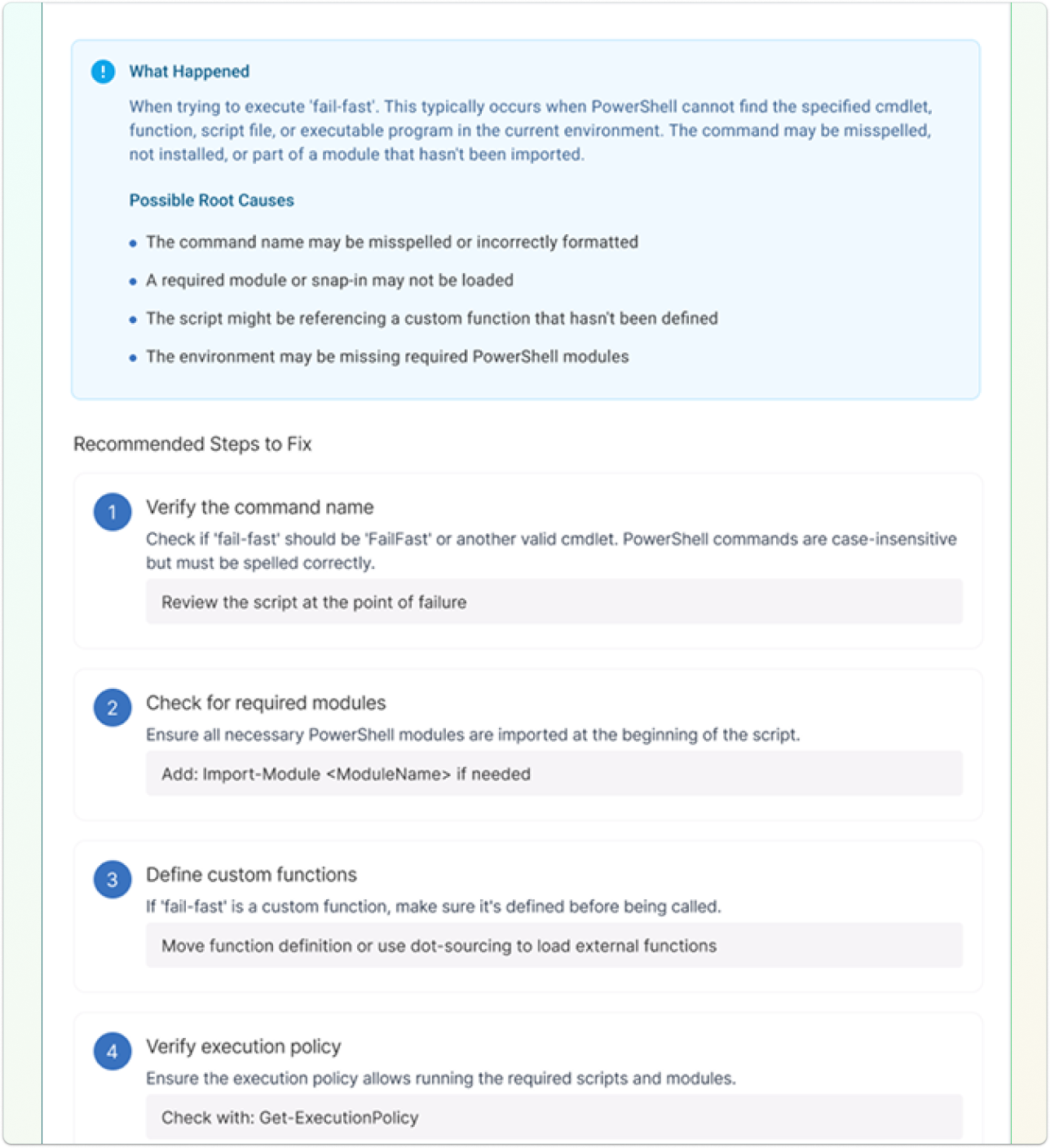
Intelligence appeared directly alongside logs and metadata, translating technical outputs into interpretable reasoning without obscuring the underlying data.
The panel distinguished clearly between explanation and recommendation. No actions were executed automatically. Operators retained full visibility and control.
Rather than redefining the workflow, the solution accelerated it.
Failures could be interpreted faster, resolution paths became clearer, and new users gained guidance without disrupting the precision experienced users relied on.
AI enhanced the troubleshooting experience without replacing it.
AI enhanced the workflow without redefining it.
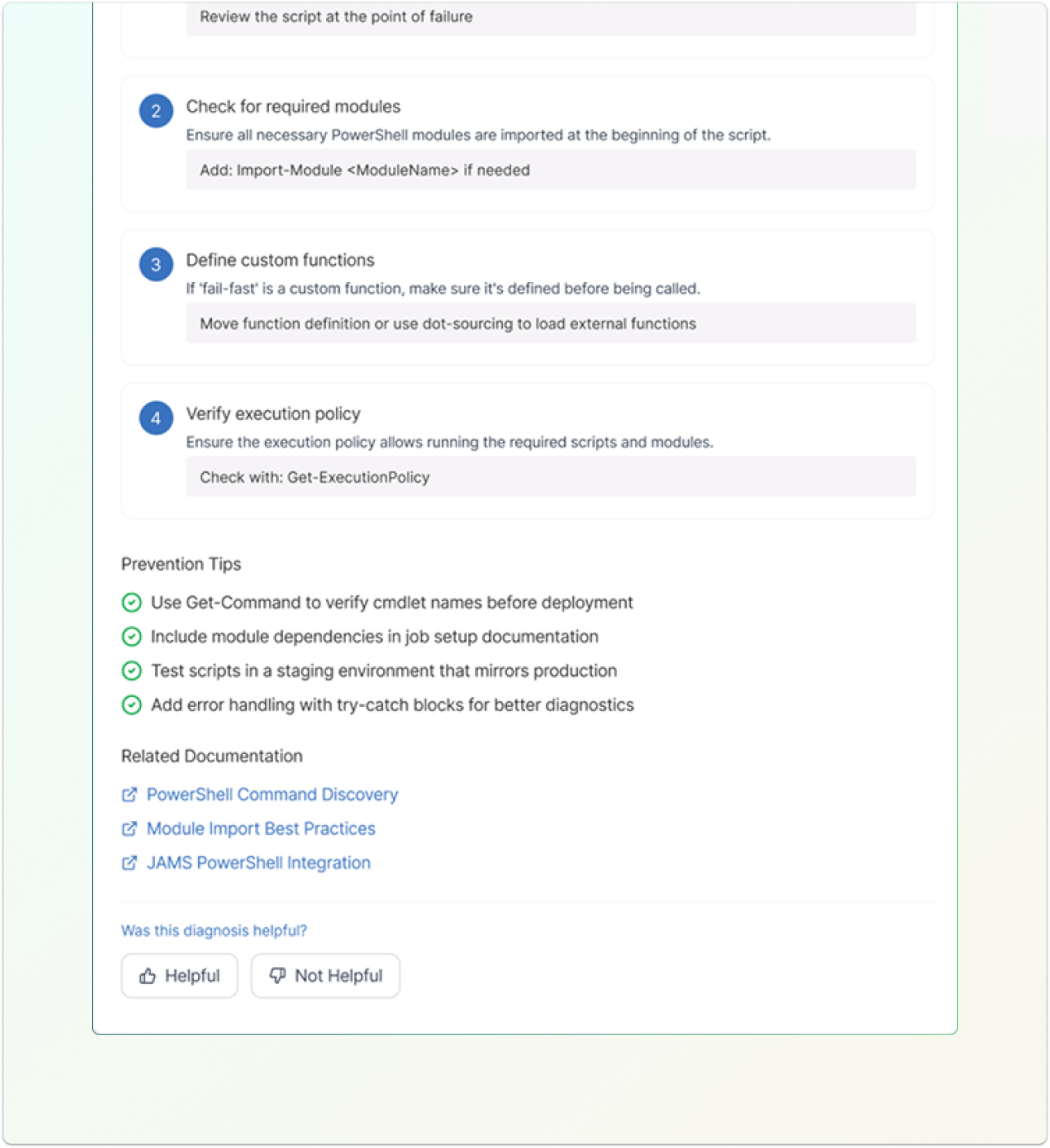
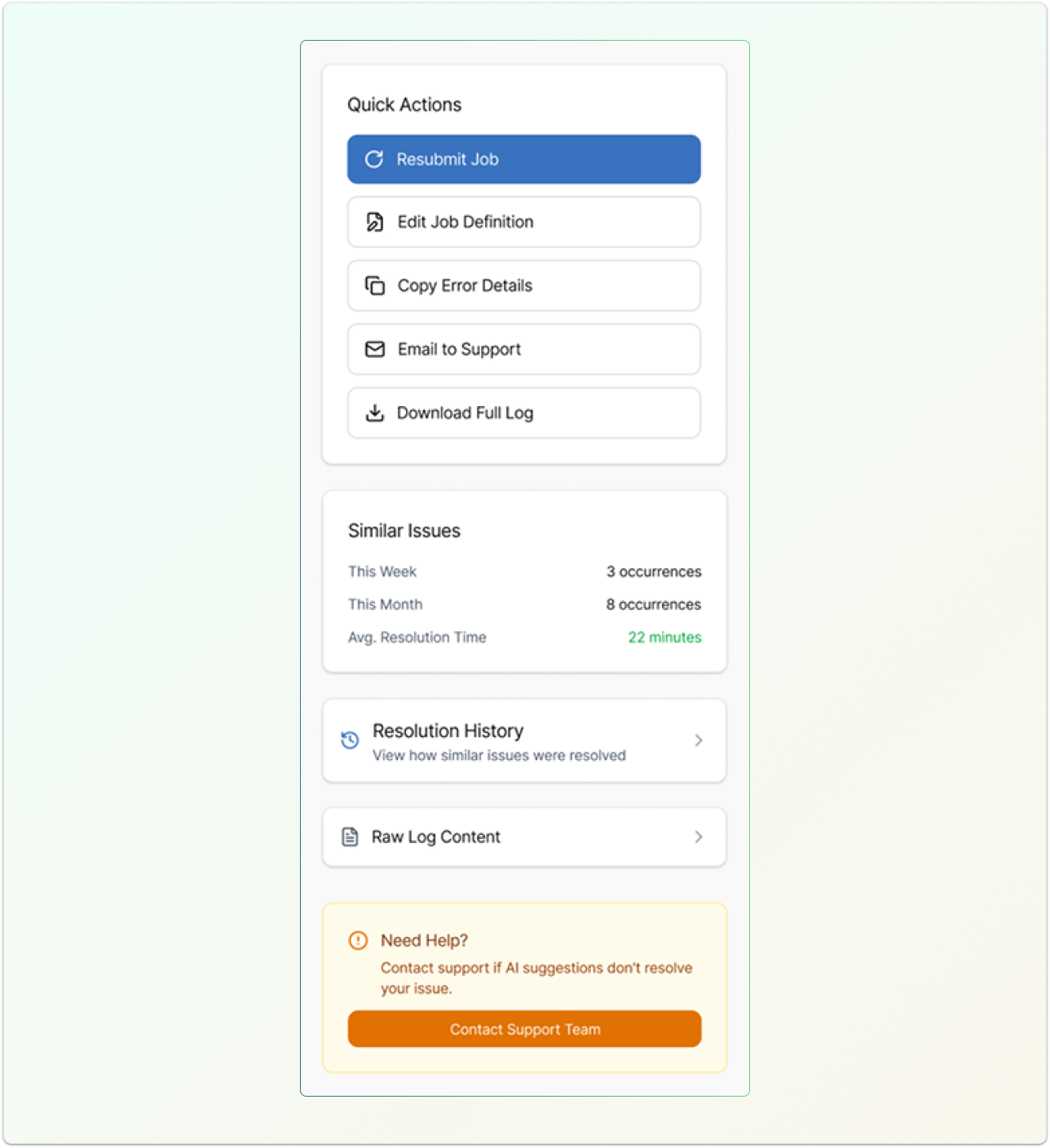
Embedding AI within the troubleshooting workflow reduced the reliance on institutional knowledge while preserving system precision and operator control.
Failures that once required deep experience to interpret could be understood more quickly and consistently.
The impact extended beyond usability improvements:
Because intelligence was layered into existing workflows rather than replacing them, adoption remained high among experienced operators.
The system became easier to reason about without becoming less precise.
This implementation also established a repeatable pattern for embedding intelligence across other areas of the platform, creating a foundation for future expansion without architectural disruption.
Most established platforms cannot afford to rebuild their core experiences around AI.
They operate within mature systems shaped by operational constraints, regulatory considerations, and deeply embedded user habits. Precision, reliability, and trust are not optional.
For these organizations, the question is not whether to introduce intelligence, but how to do so without destabilizing what already works.
This case demonstrates a practical model:
When AI is layered thoughtfully into critical paths rather than positioned as a replacement interface, adoption increases and system integrity remains intact.
This approach enables companies to evolve structurally. Intelligence becomes part of the platform’s fabric, not an external overlay.
For enterprise products with established workflows, sustainable AI integration requires architectural sensitivity as much as technical capability.
That is where disciplined design strategy matters most.

If you’re curious about how AI could support your product and your users without overcomplicating things, we’d love to explore it together.
Start a conversation